This is Spine
Everything is fine
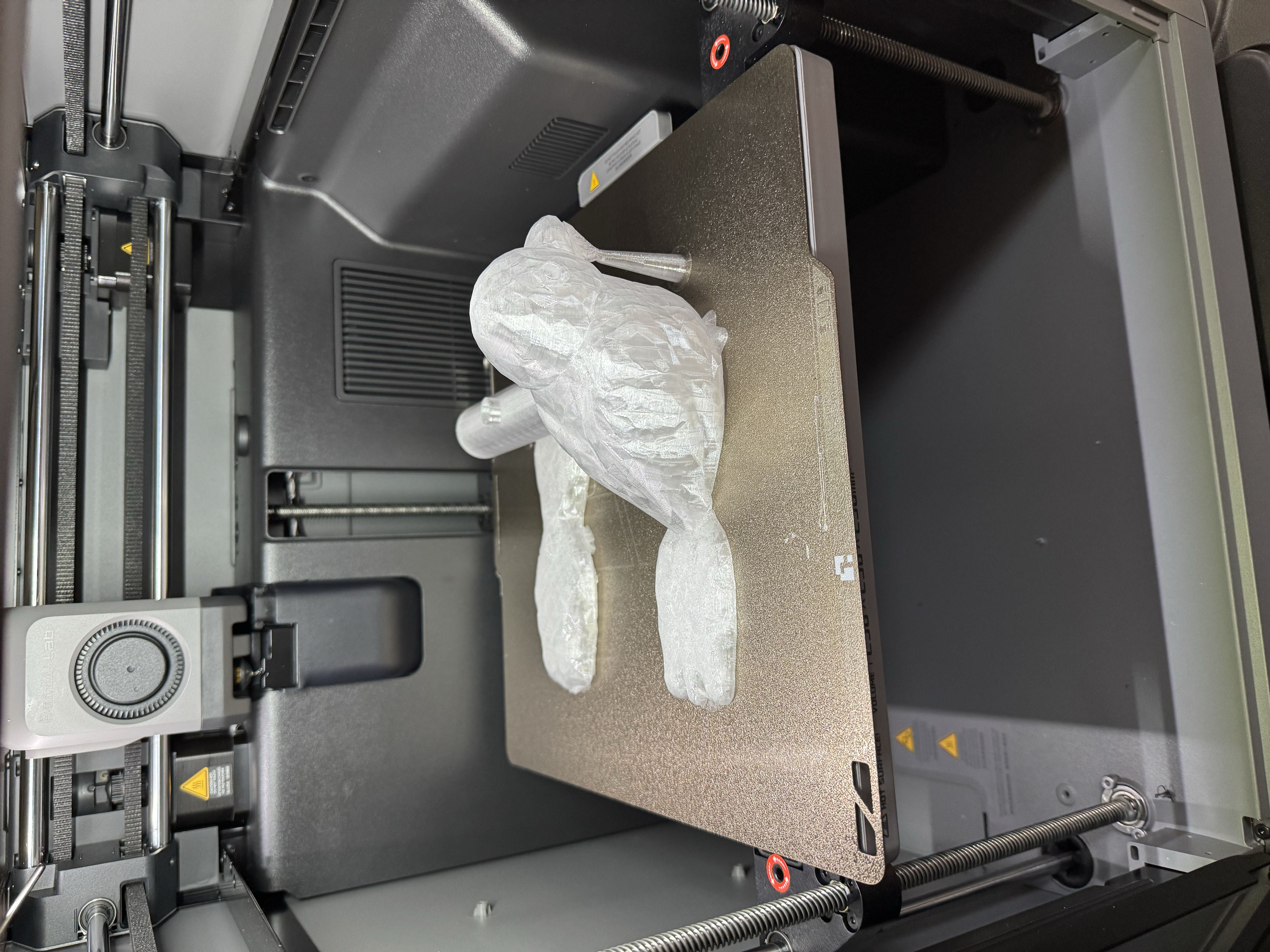
I have been in a press fit purgatory for the better part of a week. The concept is simple: two halves of a shell that snap together. The reality is that 3D-printed tolerances are suggestions, not promises. Too tight and the halves won’t close. Too loose and they fall apart in your hand. Just right and you feel like a genius for about thirty seconds until you realize the sensor window is on the wrong side again.
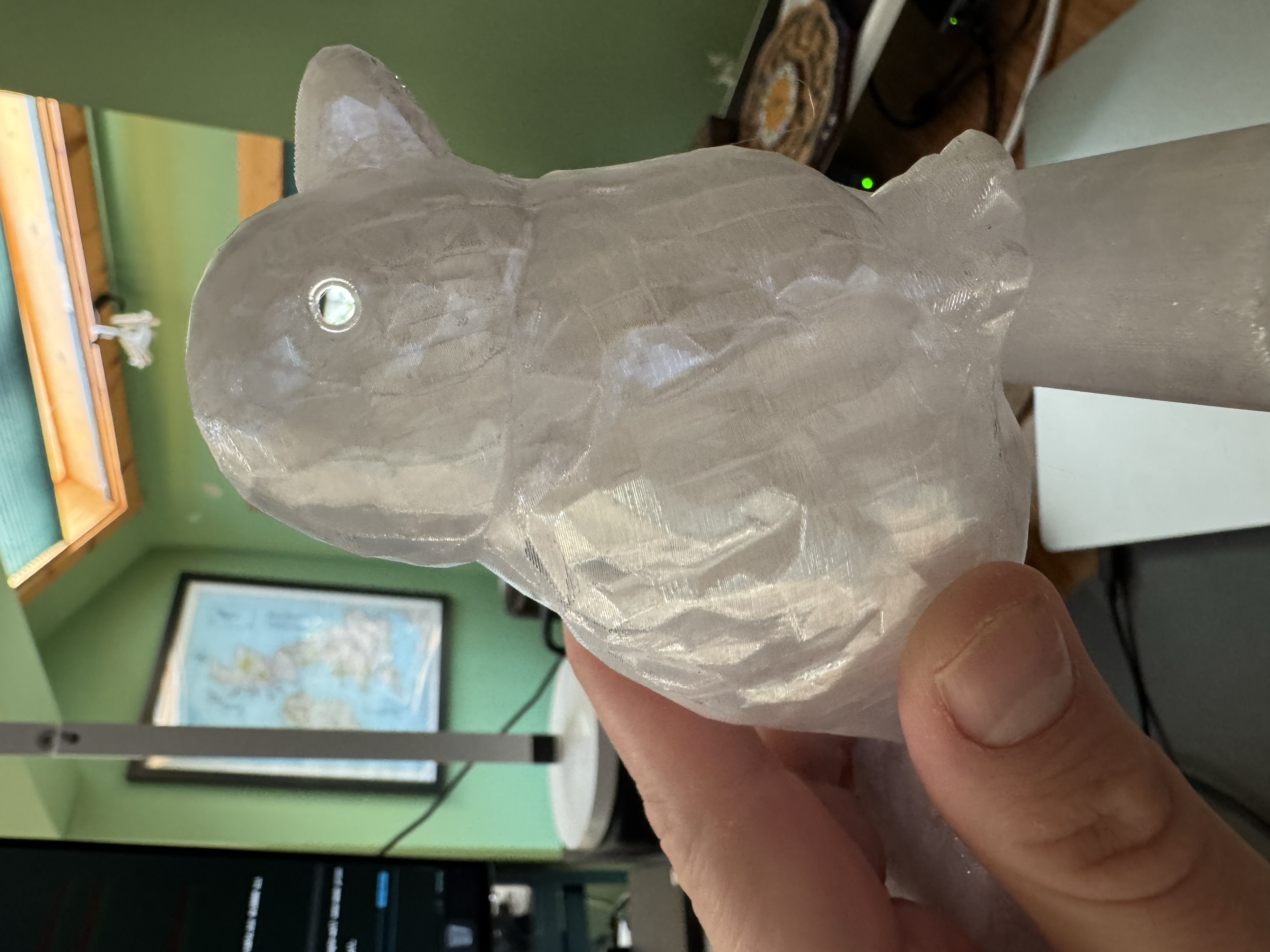
After more iterations than I’m willing to count, I finally got a fit that holds. And then I printed it in PETG.
The greenhouse problem
I stuffed the breakout boards inside, sealed her up, and put her outside for a side-by-side test with the bare prototype. Within an hour, the temperature sensor inside the enclosed bird was reading 99.9 degrees on a 60-degree day. The white PETG shell was acting as a greenhouse. Sunlight gets in, heat doesn’t get out.
This means the temperature and gas sensors can’t live inside the body. They need to be exposed to actual ambient air, not the microclimate inside a sealed plastic bird. The VOC sensor especially needs airflow to get a meaningful reading. A sealed enclosure just measures its own off-gassing.
So the head needs to be the sensor compartment, with vents or openings for airflow. And the head cavity is tiny.
The three-piece solution
I spent a day staring at the model trying to figure out how to get components into a space that’s barely bigger than the components themselves. The answer turned out to be: don’t. Don’t try to assemble everything inside the body. Give Phoebe a spine.
The new design is three pieces. The Perch is the battery and port housing at the bottom, same as before. The spine is a rail that slides up through the hollow body. The ESP32-C6 mounts to the spine. The head is a separate piece that latches onto the top of the body.
Assembly goes like this: install the sensors in the head, mount the microcontroller to the spine, slide the spine through the body from below, connect the head sensors to the spine, and lock the head into place. Everything is accessible before it’s enclosed. No more trying to solder wires inside a cavity the size of a walnut.
Sharp-eyed viewers will notice my Fusion 360 trial expires in 3 days. Also visible in the timeline: “Sketch 22.” I don’t know what Sketch 22 does. I’m afraid to delete it.
Plans mode
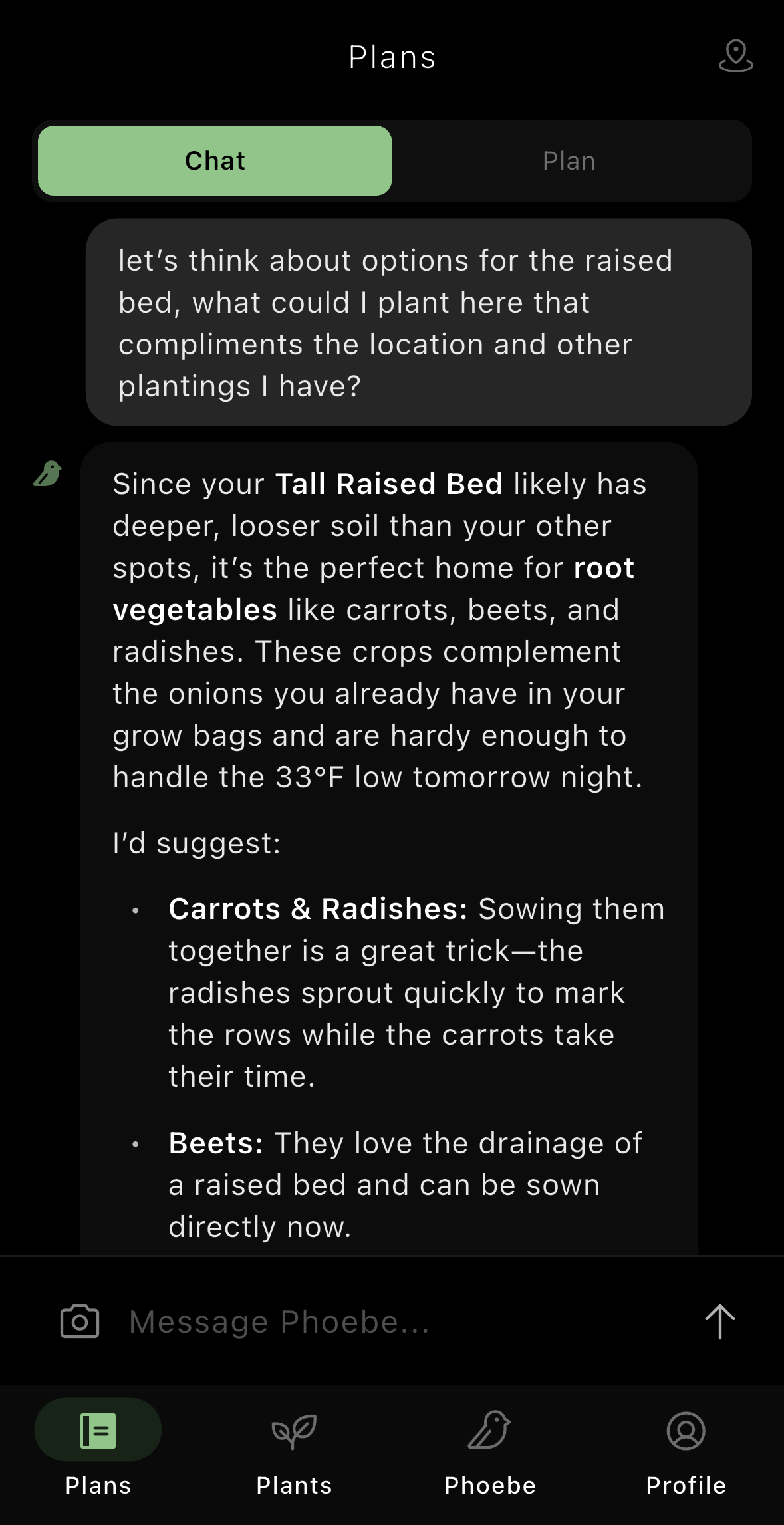
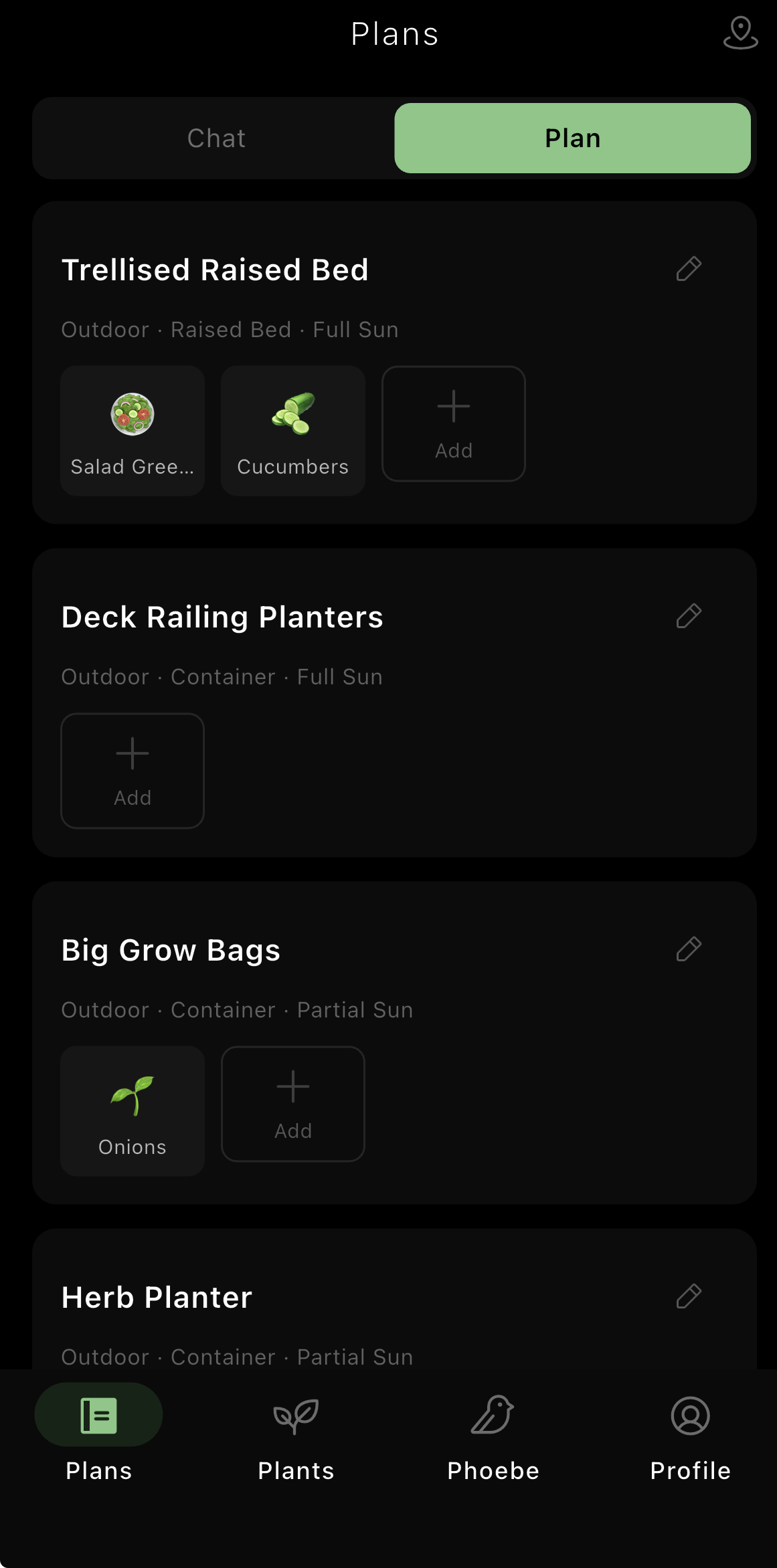
While the printer was running, I added a new tab to the app. Remember the animated scene system from a few posts back? The one where I predicted half of it wouldn’t survive the week? Called it. Places is still there as an easter egg, but the main nav slot now belongs to “Plans,” which has two modes.
In Chat mode, you talk to Phoebe about what to plant. She knows your locations, your soil types, your sun exposure, your hardiness zone, and what you’ve already got growing. Ask her what to plant in the raised bed and she’ll suggest things that complement what’s already there, accounting for the weather forecast and your local frost dates.
In Plan mode, you see all your locations as cards with planting grids. What’s growing where, with room to add more. It’s the garden overview I kept wanting but didn’t have.
Under the hood, Phoebe now has separate chat modes with different prompts, tools, and context depending on whether you’re planning, asking about a specific plant, or just chatting. She can also create and update locations and plantings directly from the conversation, so you can go from “I want to start tomatoes” to having them on your plan without leaving the chat.
In the wild
Meanwhile, the test bird is outside doing her job.
There are currently two Phoebes in the cold frame: the old black PLA prototype and the new white PETG one, running side-by-side with different VOC sensors to compare baselines. The black one is the old two-piece model that doesn’t actually fit together or fit the sensors, so the breakout boards are dangling off the back like a backpack, the ESP32 is crammed inside, and the whole body is held together with electrical tape. Between the two of them, these are probably the most closely monitored brassica seedlings in the known universe.
Yes, the temperature readings are wrong because of the greenhouse issue. Yes, the white one is held together with friction and optimism. But they’re birds, in a garden, watching plants. The engineering will catch up.
— Ben