Small Bird Saturday
What the sensors actually said
Alert Auk has been running for two days. Some sensors surprised me. One got fired.
The UV sensor was the star. It reads exactly zero indoors. Grow lights, glass, LEDs. Zero. Step outside and it’s immediately non-zero. It caught the exact moment I moved seedlings outside yesterday, jumping before the light sensor even noticed. A bright grow light and a cloudy day look similar in brightness. In UV, they’re completely different worlds. Sometimes the backup plan is the plan.
The nose is a slow burn. Phoebe has a volatile organic compound sensor. Basically she can smell the air. Soil microbes, fertilizer, cooking, forest terpenes, and the stress chemicals plants emit when they’re in trouble. A single sniff can’t distinguish any of those. But Phoebe learns what “normal” smells like for each location over weeks. Then a spike that doesn’t track with temperature is a real signal. “Something changed and it’s not just the air warming up.” That’s how she might catch pest damage or root rot before you see it. Patience, not thresholds.
The microphone got fired. It worked. I could read a loudness number. But “how loud” doesn’t distinguish wind from rain from trucks from caterpillars. And a microphone in someone’s home is a liability I don’t want. Replaced by a piezo contact transducer, a tiny vibration sensor that presses against the plant stem. It picks up tiny vibrations traveling through the stem, things like a plant’s internal plumbing cracking under drought or an insect chewing on a leaf. Way too quiet for speech. Under 50 cents. Better in every way, and nobody has to wonder if their plant sensor is listening to their arguments.
The real value is the combination. Moisture says “how wet.” Temperature says “how fast it’s drying.” UV says “real sun or grow light.” The nose says “does the air smell different.” The vibration sensor says “is the plant cracking or being chewed.” Each one alone is a number. Together, Phoebe reasons across them: “This pothos is drying faster than usual, the air smells different than last week, and the light pattern shows it moved closer to the window. Probably transpiring more from the extra light. Nothing to worry about yet.” That kind of cross-channel reasoning is what no soil moisture meter can do. The sensors are cheap. The intelligence is in the fusion.
The app needed work
I’ve been dogfooding the app for a few days and I hated it. Navigation was confusing, adding and editing things was clunky, the chat would hang at the end of conversations. So I tore it apart. Mostly cosmetic, quality of life stuff, but it adds up. Also gave Phoebe a new tool: she can now rebuild her world model on demand instead of waiting for the 6-hour cycle. Ask her a question about your plant and she’ll recompute the physics first.
Perch
With the sensor suite starting to solidify, I grabbed a whiteboard and an 18650 battery enclosure and started thinking about what Phoebe actually looks like as a product.
Phoebe is a small bird that perches on a stick in your plant pot.
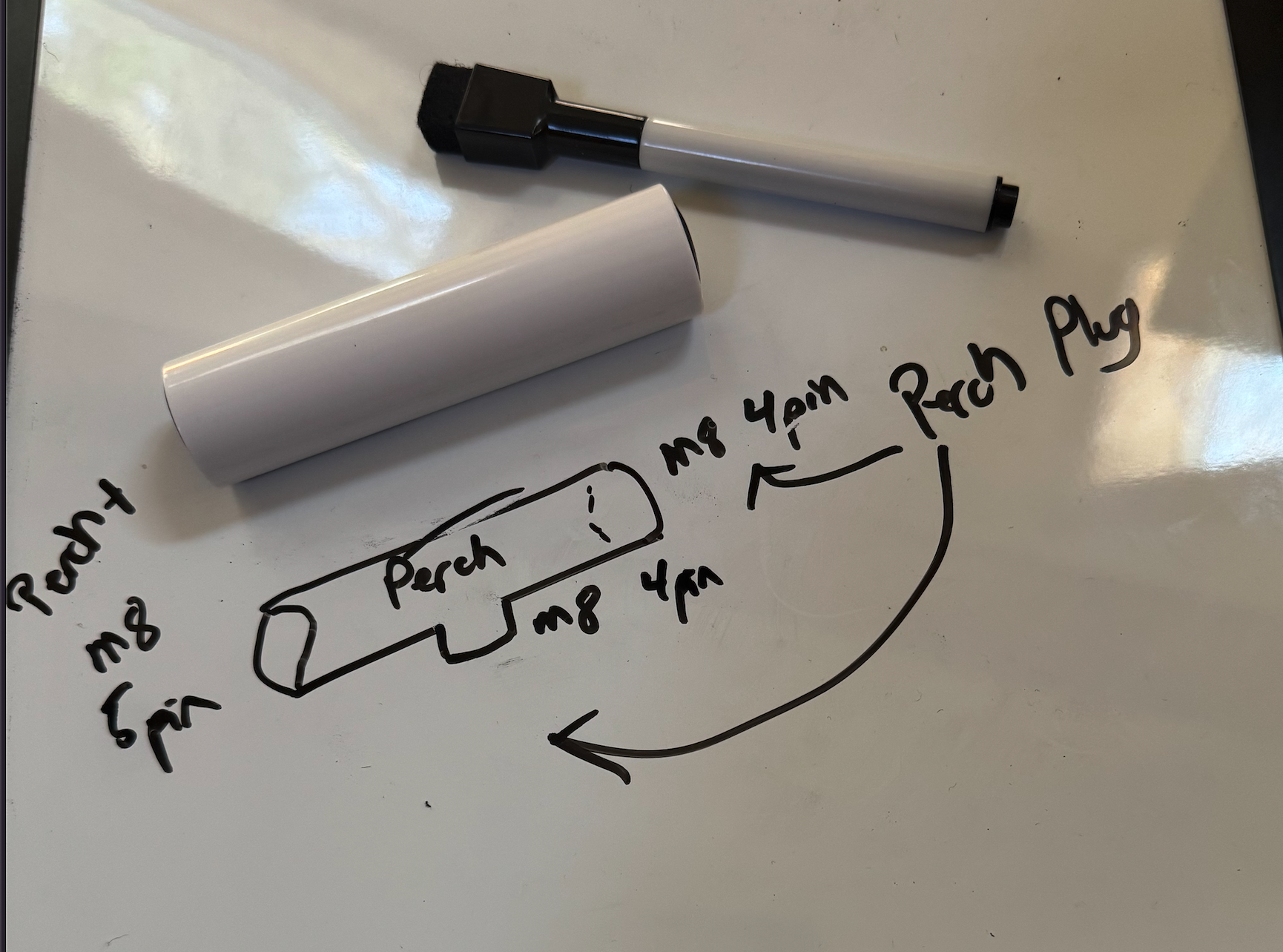
The bird is the brain. Microcontroller, WiFi antenna, a light sensor behind its eye, and a VOC sensor that lets it smell the air. The stick it sits on is the Perch, a horizontal housing that holds a rechargeable 18650 battery and all the connection ports. USB-C on one end for charging, and standardized M8 waterproof connectors for accessories. The 18650 enclosure next to the sketch is basically the spine of the whole thing.
Out of the box, two accessories plug into the Perch. A soil prong connects to the bottom port and pushes down into the soil, measuring moisture and temperature. A leaf sticker, a small leaf-shaped piezo pad, adheres to the plant’s stem and connects to the side port via a thin brown wire. It detects drought stress and insect damage through vibrations. Not a microphone. Cannot record audio. Both accessories are field-replaceable: when the soil prong corrodes or the adhesive wears out, you swap them for a few dollars.
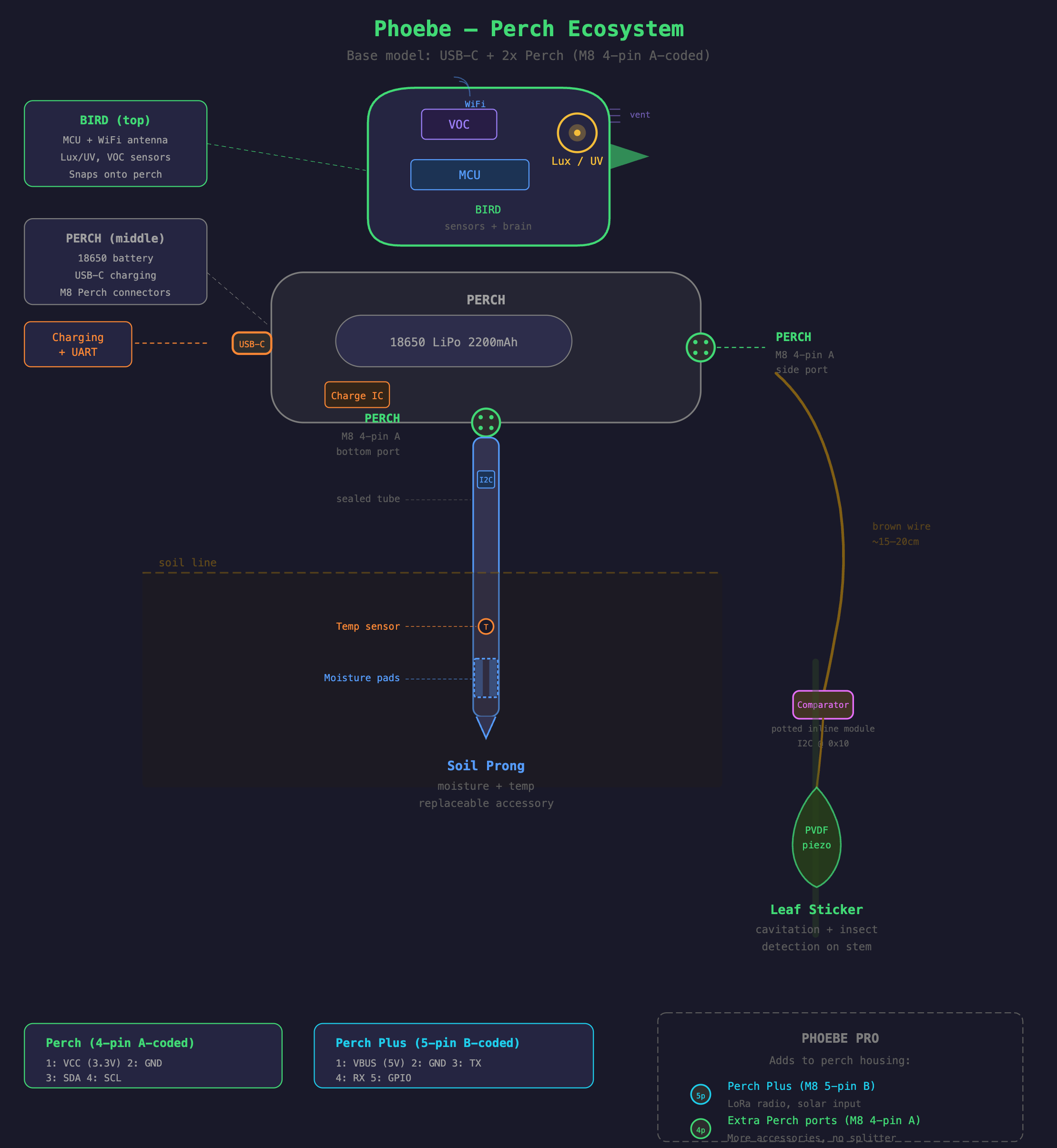
The bird never touches soil. It has no parts that wear out. Everything that degrades or varies by use case is an accessory on the Perch bus. One bird, many plants, many configurations, all through the same two connectors.
Open hardware
Perch is designed for third-party accessories from day one. Standard M8 connector, standard I2C protocol, documented pinout and address map. If someone wants to build a rain gauge or a stem caliper or a nutrient sensor that plugs into Phoebe, the spec is published and the bird will discover it automatically.
I don’t know if anyone will actually build Perch accessories. But designing for it costs nothing extra, and closing the ecosystem off would be a choice I’d regret. Open connector, open protocol, open docs.
This is still a whiteboard sketch next to a battery enclosure. But it’s the first time the hardware vision has felt like a real product instead of a pile of dev boards. A little bird, perched on a prong, watching your plant. Everything else plugs in.
All of this happened before noon. Saturday mornings hit different when you’re basically making your own cartoon character.
— Ben